
I get to talk to quite a few young people as a town car driver. Many are interested in psychology, but they don’t know where to begin. So, I am writing this to provide an introduction, a very relevant group of books I read years ago that impressed me.
My exploration into psychology began with my loss of religious faith. The belief, the very idea, that God existed was totally at the center of my world view. My first experience that was a harbinger of my subsequent loss of traditional faith was a conversation with my eight grade religion teacher at a Quaker school, William Hubben, the Quaker representative to the Vatican Council, and author of the book, Dostoyevsky, Kierkegaard, Nietzsche & Kafka (that figures into another shaking-my-head synchronicity at a much later date). We were talking about the “Miracle of the Loaves and the Fishes”. He said that there was no miracle, but just the generosity of the people who were present at Jesus’ speech. For me, the problem was that if you took away the miracles, then, you took away the “evidence” that this was not a “regular man” , so to speak, but someone on a much higher level spiritually, whose word had to be respected, in essence, as a command.

The next year, the new head of the religion department, Mr. Harrison, polled our class regarding our belief in God. I had, then, as I have now, no doubt whatsoever about God’s existence. That belief was a shock to him. He gave me a puzzled look.
It was as if someone as intelligent as I was known to be should not have had this point of view. I was uncomfortable under his scrutiny. He was a very “modern liberal” type and a Quaker.
The “coincidence” was next. A Time magazine issue come out with “Is God Dead?” on the cover. I am not sure if it was before, but I think it came out after that incident, and it came out as I realized that my belief was not based on anything substantive, firm, or decisive. I surrendered to its loss. Of course, this is “synchronicity” big-time, and I have a lot of these stories. I have insight into how atheism comes about, but I will save that for later. In fact, this experience lies behind Nietzsche’s and Jung’s loss of faith. Nietzsche failed to solve the problem as to the next step. Jung did, from my point of view and my own experience. Both lost their traditional faith reading the biographies of Jesus in the late 19th century that took an entirely secular approach to Jesus’ life. One very compatible with Mr. Hubben’s outlook. Morality and God were very real to Mr. Hubben, though. He worked in the underground in Germany during WWII. On once occasion, his wife hid the list of spies they were working with in her bra, and, for some reason, the SS made no demand on her to be strip-searched.

So, after losing that sense of certainty of God’s existence, seeing it simply as untenable rationally, then came three weeks of feeling very changed in a changed world. The world felt unreal, as if I were experiencing it through a slight fog or alteration of atmosphere. I told no one about it. I mean literally no one.
In the future, I will write about this in detail. I saw prejudice in news stories for the first time in my life. I read the book, 1984. That really affected me amplifying what I felt. Here you had a godless society. I saw in my mind’s eye a kind of superstructure over the world and that when I was an adult I would be part of a group that knew about and understood this “superstructure”.
A foreshadowing of becoming a follower of Jung, Gurdjieff and others in that area, such as Robert Graves and Joseph Campbell? That’s still how I see it.
Because of that experience, I felt, and believe it today, that people lose faith in the existence of God either by believing that positing God’s existence is untenable for minds ruled by reason and science and, secondly, by wondering about what is called “Theodicy”. From the German natural scientist and rival to Newton, Leibniz, the term refers to the attempt to justify God’s world using the morality and values we traditionally believe to be part of God’s nature.
Years later, having recovered from atheism with a “peak experience” (Maslow’s term), a psychic told me that I knew God existed but I didn’t trust God because I came from (i.e., grew up under) evil. I agreed.
This, as you can see, gets complicated. Definitely future blog material!
So, having lost my faith, I was open to science and to the scientific study of psychology. I had quite a way to go. Not until my mid-twenties did I feel I had really understood scientific method and understood, that, while I agreed with Freud and Jung (especially Jung) about the nature of the psyche, there was no way that what they offered was “science” but that did not de-legitimize either of them.
The crux of it is that the study of subjects can never be pursued entirely by laboratory methods. Introspection is legitimate but obviously error-prone.
So about the books and some films.
The first one is not a recommendation. It is, however, a good story that starts with a book. I have this book I had “run across” in the library, right there on one of the tables. I had not been looking for a book on Freud but it “crossed” my path, nevertheless. It talked about “Freudian slips”, but what really got me was this:
So, you are at a dance and your friend is there, like you, with a date. He tries to introduce you but suddenly, inexplicably, forgets your name. Wow! Why? Because he considers you a threat because he is afraid his date will be strongly attracted to you. OK!
Within a few weeks, there was our spring dance and I went with a date. I don’t remember who. Our private school had only seventy-five students in our class and everyone knew everyone’ s name quite well. But, when I approached him, he smiled sheepishly and apologized because he couldn’t remember my name!
I laughed to myself and, as I did not consider myself particularly attractive to young women, I was surprised. The event is an example of synchronicity. What little I had just learned regarding Freud got validated. My friend’s unconscious took over and solved his problem for him. Same mechanism for hysterical blindness and paralysis.
That summer I read the autobiography of Helen Keller. Coincidentally, I got to see the film with Ann Bancroft and Patty Duke as Helen Keller. I wanted to know what went on in the mind of someone who could neither hear nor see.
I was trying to understand the “blank slate” we are supposedly born with. If you eliminate sight and hearing, then most of the conscious mind remains undeveloped. What is left would be the “ground of being” of the psyche before the mind existed. The mind is premised on the psyche and not the psyche on the mind. The mind is both the product of our greater deeper psyche and outward socialization. It fosters what is called the “persona”. Essentially, the name, taken from the masks that ancient Greek actors wore playing the characters of the play, simply means “personality”, how you relate to the outside world. Your “ambassador”, and not your true self.
In her autobiography, Helen Keller describes herself as a mischievous child who regularly locked people in rooms, ate food with no manners at all, stuffing the food into her mouth. Of course, completely intractable. I was intrigued by her antics of locking people in rooms because it demonstrated intelligence, and an enjoyment of the exercise of power. I didn’t expect to read that.
Her family sends for a teacher, Ann Sullivan, who is a force of nature. She works on Helen, teaching her Morse code to try to put words into Helen’s psyche.
Helen learns the codes, but she doesn’t get how they refer to actual objects.
The most important event actually comes when she finally gets who and what her parents are. Ann Sullivan had taken total control of Helen. They lived in a cottage apart from the main house where Helen’s parents couldn’t interfere with Sullivan imposing discipline that the parents saw as too harsh. They plainly felt sorry for their daughter.
She learned to eat with a fork and knife. At a certain point, Sullivan takes her back to the family dining room where, knowing her indulgent parents are present, Helen reverts to her previous behavior. She creates a complete mess of the table, and destroys the positive welcoming atmosphere that her family had extended her.
Sullivan wants her to clean up the mess, beginning with herself. She takes her outside and, in one of the most memorable scenes I have ever seen in a film, takes her to the water pump, and makes Helen clean up. While Helen is doing this, spells out “w-a-t-e-r” in Morse code on her hand over and over.
That’s when the miracle begins. Suddenly, it dawns on Helen that this Morse code being tapped out on her hand is a code for the water itself. Flashes of understanding run through her as she goes from object to object getting Sullivan to teach her yet another name.
Then, the real peak of it all happens. Suddenly, Helen is seized by the desire to know the code for her parents. Ann gives it to her. What follows is absolutely mind-blowing. She not only gets the name as code but is emotionally overwhelmed as the understanding of who they are as parents, the embodiment of the archetype of father and mother, flood through her.
I am going to write at greater length about the nature of archetypes and the collective unconscious, and how this experience of hers validates Jung’s point of view. Those archetypes get access to her conscious mind and that is why she gets, not just a name, but a total experience of her parents as parents.

Then my education about Freud began. I knew I was looking for something back behind my mind. I had the strongest sense that understanding this, getting to know this “whatever”, was next on the list.
That’s when I got to see Montgomery Clift as Sigmund Freud in “Freud’s Secret Passion”.
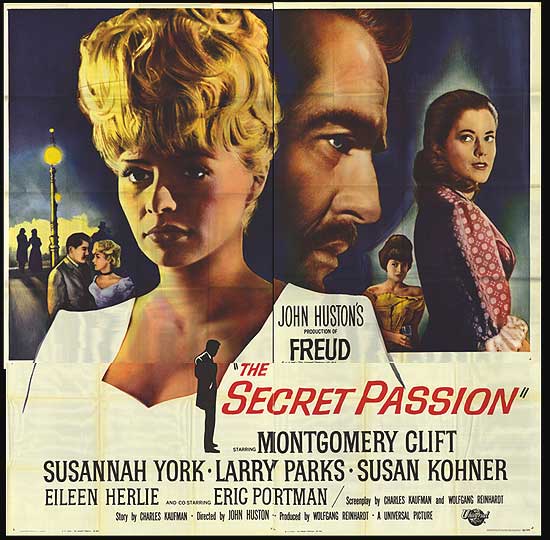
Over the years, I have learned that it was, in effect, a total piece of propaganda. Originally a script of twelve hours (!) from Sartre, the philosopher. They chopped it down and made a very watchable movie. The film deals well with the whole problem of the “hysterical” symptoms people often experienced at that time and the genesis of Freud’s correct understanding as a neurologist of a psychoneurosis versus a lesion in the nervous system.
Freud’s Secret Passion. The trailer.
Hysterical blindness. Hysterical paralysis. The question was: is there a lesion in the neurons or does the hysterical blindness/paralysis reflect the power of the psyche to create an actual blindness or paralysis (validated with e.g., pin pricks)?
For this, young Freud goes to Paris to study under the eminent neurologist Charcot.
Charcot was a leading figure in neurology. The term, “Charcot’s knee”, refers to the battered knees of men and women with advanced syphilis that, due to the loss of their proprioceptive neurons, don’t “know” where their knee is in physical space. As a result, they bump their knee into so much stuff as to permanently damage it.
Dr. Charcot had realized that what came to be known as hysterical paralysis and blindness was not the result of a neuronal lesion and that these disorders could be treated with hypnosis.
In fact, the hysterically blind patient could, under hypnosis, either regain the faculty or be directed to some other hysterical symptom (e.g., paralysis).
This is well done in the film and essentially all accurate.
This validated a view of the psyche outside of the “mind” as an “unknown” of real significance. This is when the “Unconscious” takes center stage as the real object of study of psychology. This is where modern psychology begins.
Freud took this all in. In the film, there is the case of Ida Bauer. She suffered from “petite hysteria”–loss of voice, difficulty breathing, migraines, fainting spells. Freud begins to understand that the whole story he’s been getting from Ida is false. She claimed her father died in a Protestant hospital at midnight where music had been playing. He figures out that it wasn’t a hospital but a house of prostitution. And, so it went. He starts to interpret dreams and decode the real meaning behind them, a meaning that the patient resists. Finding the real meaning behind hysterical paralysis helps restore the patient to reality and brings about (supposedly!) a reduction, if not elimination of symptoms.
Now to the books I got into about a year later.
The first one is AA Brill’s translation of The Basic Writings of Sigmund Freud.
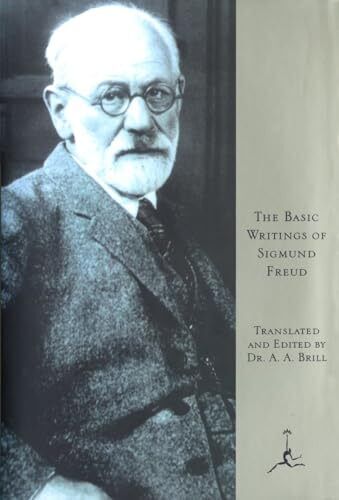
I came across this book at a study desk I had placed myself at, in the back of the library, and this was just part of a series of coincidences. I took the book home and tore into it.
I had been raised around people who mocked Freud, but, for whatever reason, it never penetrated. His writing was so reasonable and well-argued that I immediately adopted his point of view. This reasonableness and his reasoning itself, helped me shift to his position. I became a total fan. I would stand in a bookstore and read his books if I didn’t have the money with me to buy them.
My position, even then, was that to understand something really well, I had to take on the point of view of the author. Because Freud was such a good writer and thinker, I was totally convinced of both the validity his point of view and that what he was doing was, in fact, science. I had had a very good chemistry course and other courses (bio- and physics), but, I have to say my grasp of scientific method was really incomplete.
I began to interpret my dreams and won a prize in our school essay contest on the interpretation of dreams.
The first section is The Psychopathology of Everyday Life

Freud proposes here is (what should be considered…) a conjecture regarding slips of speech or incidents such as the one where someone who knew my name well, could not remember it all.
I was playing pool at a friend’s house. His sister was about fifteen. She was talking to a friend and couldn’t remember the name of a candy story they went to as kids. “Lipsky’s” turned out to be the name.
I immediately assumed her memory glitch was due to the fact of her being in a room full of teenage boys. A few years later, I realized that my certainty was not justified. It may have been true, but I then had the sense of what would be involved in something really scientific.
I will get to that in a subsequent essay.

The second part of the book was a translation of The Interpretation of Dreams.
A.A. Brill was the translator who invented the catchy, ominous term, “Id“, for the unconscious. Freud had called it (in German) “das Esse”, or “the it”. Brill was right that “the it” lacked something and substituted “Id” (Latin for “it”) and helped create a better way to propagandize Freud’s psychology.
Then I got a hold of Ernest Jones’ biography of Freud. Reading this you get a better view of the whole developmental process.

It is essential reading if you want to really get Freud. Ernest Jones was English. Basically, everyone in Freud’s immediate circle was Jewish. Freud actively sought others such as Jung and Jones to help his psychology be seen as something universal. As I said…a “must-read”.
Lastly, I came across a book, A Primer of Freudian Psychology by Calvin Hall.

Without a doubt, it’s a great summary. I believe it helped me get quite good at the manipulation/use of Freudian terms to explain behavior. I had some very good conversations with a psychiatrist I knew. Over time, I actually revised my point of view regarding Freud, both from my errors resulting from misunderstanding what I had read and my own lack of understanding of the practices and principles of scientific method.
I say that, due to the structure of the psyche of modern man with its overemphasis on the conscious mind with its denigration of the “unconscious”, the “Id”, of Freud, you can get basic Freud down in months. In other words, Freud’s explanations leave us in charge, “apparently”. Freud called dreams “the Royal Road to the Unconscious”, but his view was not like Jung’s. His point of view extends our apparent control and our faith in our conscious mind and in the modern mind’s rationality, the war vs superstition. This includes our whole view of “primitives” as being, perhaps good people, but, in the end, we see them as foolishly prey to the sense of something greater outside of our psyche.
Synchronicity? “Bah! Humbug!” Here’s what Jung thought of Freud’s take on the Unconscious. I have never found anything better. Extremely succinct and on target.

Very few people really get this. Freud, the neurologist, was dependent on Jung’s work on word association experiments to validate the notion of the Unconscious. More to come.
Next up…books on Jung.
 Contrary Warrior Health Blog
One thought on “Part 1: Book Recommendations on Freud Help for Someone Starting Out in this Area. Jung to Come Part 2”