
Hello. The picture above is Gurdjieff, the man who brought this teaching to the West at the time of the Russian Revolution. His most famous student, P.D. Ouspensky, chronicled his experience as G’s student and wrote what is considered the seminal, and the very best book on the doctrine, Gurdjieff taught. The book is called, In Search of the Miraculous.

This teaching is very demanding and not as well-known as the writings of Carl Jung.
Call it vanity, but I want to begin this short essay, this introduction to Esoteric Christianity, by describing how all of this fatefully crossed my path. Then, in Part Two, we will get to the books themselves, the key books, most germane to get acquainted with, and, then, hopefully, the reader can adopt some of what belongs to this basically overlooked and underappreciated spiritual practice.
But before that, it would be essential to talk about Synchronicity. It’s a word that Carl Jung popularized, but which derives from similar forms going all the way back to the 1580s. His popularization of the term itself, “synchronicity”, is from the end of the 19th century.

It’s an inherent part of his system and worldview, but, for now, I have introduced it to help focus on how I first got into this.
As I say often, mere knowledge of a system is never enough. You can only really understand a system if you know about its development and, in this case, the how and why it got popularized.
I also maintain that a perspective regarding the speaker/writer’s own development is more than just useful. It is necessary to give essential human context to what otherwise is just a system.
So, since my early teens, having lost faith in God’s existence, I looked for the answer to this nagging sense I had of something important behind the entity we called “mind”. That’s when I first got into Freud, to be covered in another blog. Freud’s point of view, being that he was a scientific atheist, was easy for me to absorb.
After spending two painful years with chronic migraine while attending med school against my will, I got myself into a program of “Primal Therapy”, the therapy John Lennon did with Arthur Janov. The album “Imagine” came out of that. His song, “Mother” has him expressing “primal pain” while singing about his relationship to his mother. That screaming you hear is an actual “primal pain” cry. Amazing man! He writes a song about his pain and includes its full expression. Basically, the world does not know and does not appreciate what full expression is. We see it in others, but the tendency is to doubt we have that power.
Full expression is, in fact, taboo.
Our whole childhood is an experience of dampening. Of stunted emotional expression. Sometimes it is because the situation does not permit it. Or, perhaps, full emotional expression concerns the parent as being the hallmark of a child who thinks he can get what he wants if he protests vociferously enough. Most abusive parents cannot tolerate the evidence. Ouspensky actually talks how we are not emotional enough in one of his essays in The Fourth Way, a series of questions and answers regarding the teaching.
As I said, the world’s orientation to itself is premised on dampening down. On making a person tractable.
A while after I had finished the three week isolation with no contact outside of the therapy- no TV/radio, reading, sex, alcohol. My roommate and friend showed up in Berkeley with his close friend, Eddy. Eddy was reading a book, Tertium Organum by Ouspensky, Russian mathematician and writer. Now, it gets really “synchronistic”.
While walking around the tourist area of San Francisco, a young man approached them to sell them tickets to a play, “Adam King”. The play was at the “Everyman Theater”, the name referring to a Medieval morality play about what “Everyman” had to do to stay in grace and get to heaven. Alex Horne, a man of controversy, was conducting an Ouspensky-based school derived from the teachings of G.I. Gurdjieff.
They both attended the play. I saw it much later. I can honesty say it was excellent, all of it based on Gurdjieff’s teachings. They both also signed up to be in this “esoteric” school at some real cost. I did get invited to a meeting to maybe get me to join. Hey! I answered an important question the “wrong way” (apparently!) and got booted out of the meeting. But, they told my friends that my “vanity”, as they deemed it, my faith in my capacity to extricate myself from the very negative effects of my childhood, was “beautiful”.
I have to add, it turns out they were right. But, my evolution went step-by-step and over decades. Yes, I became quite functional but there was still more I had to do. Sometimes, I regressed. Eventually, I got to it.
Back to discovering this esoteric practice of “self-remembering”. So, my interest piqued, I went to the Shamballa Book Store on Telegraph Ave. and started perusing the Ouspensky/Gurdjieff books, conveniently placed on a set of shelves next to a bench.
What happened was that I began to get what this thing I had previously read about. i.e., “self-remembering” was. This was in a book from that a friend in Philadelphia had lent me just after I left medical school. The Master Game. But, I didn’t get it at all.

So, after reading again about self-remembering in the bookstore, yes, it was the third time and, I finally got it. There I was, walking up Telegraph Ave. toward the Berkely campus, actually self-remembering.
What was I doing? I was maintaining self-consciousness as I walked. I made an effort to continue this through the day. I clearly saw it and experienced it as something new, valuable and never talked about in any way, shape or form in my life up to then.
This led to one particular episode where self-remembering got me to see myself as not living in honesty and having to tell someone the painful truth that I had to move on. I remember that, at the moment of really seeing my bad side, I actually wrestled myself into telling the truth. I will explain in another blog what/why/how, etc.
Self-remembering has two stages. In the first, you maintain self-consciousness and observe yourself with a much greater objectivity than you would normally have.
At a certain point, you reach the second stage where you actually hear a voice with its “boos” and “yays” responding to your behavior.
Out of that, you can deconstruct your false personality, and undergo a rebirth of yourself. This means you the false personality that possesses you and, becoming genuinely sincere, you begin to live from “essence”, what you were born with.
The whole experience is regarded as a Pythagorean ascension, from “do” to “re” to “me”… but, to continue to ascend to reach “fa”, you must get across the missing half-note, which you see on the piano.
Your use of self-remembering is a conscious intervention to bridge this first divide and get to “fa”. When you get to the second divide on the octave, from “te” to “do” of the second octave, that’s when you hear the voice of conscience directly and can begin to dismantle your false self.
You don’t get this? It’s not all that important. For now, just focus on becoming self-conscious. Then, try to maintain it. You will notice it is easier on the inhalation. You should stick with it for some time to get it fixed in your mind. You might also recognize that you have lived through brief periods where you are so amazed at what you find your self in the middle of, that you are gripped by this sense of “me being here”.
It happened to me the first days I was in Rome. I could hardly believe it. I had wanted to live in Italy since I was a kid. I was in a state of self-consciousness that was involuntary and long-lasting.
A lot more on this later.
Completely applied over the long term, it’s a self-exorcism of false personality. It’s an antidote to toxic socialization of childhood.
In my case, this experience of conscience got a lot of its impetus from my experience in therapy. As your feeling function, i.e., your capacity to feel just how bad the traumas visited upon you in childhood becomes greater, your newly augmented feeling function begins to operate as you act and you see/feel your bad side. In the spring before I got to that major experience during self-remembering with its boos and yays, I got up in the morning and my whole bad side was visible incontrovertibly, every day, essentially, all day long.
The “shadow”, yes, it’s a Jungian term for the unseen/unacknowledged bad side of yourself. It also refers to the good aspects, needed aspects of yourself, that did not get integrated growing up or, worse yet, were denied and buried. The bad side, the denial or incapacity to experience, in a word, conscience, is dealt with in other religious practices, and is quite ancient.
The New Testament: the “beam in your eye” you cannot see, while you see the “mote” in the other’s eye. This is a great example of how being possessed by your shadow gets manifested. This is exactly what is meant by “projection”.
Jung wrote that a person reaching this stage where the therapy has gone 180 degrees has to keep his wits about him. Previously, you were the victim of abuse and sought healing. Now, it’s your turn as your capacity to feel increases, to see how the abuse fostered a negative personality, a false personality, which, ironically, made you much like your abusers.
So, I had no one to discuss this with at the time. The primal therapists knew next to nothing about Gurdjieff, self-remembering, and Jung. We did discuss self-remembering a bit. My therapist asked what I saw practicing this exercise. I told him about seeing my bad side. At that point in the Jungian alchemical process, I didn’t need self-remembering as I was involuntarily gripped by an independent will to see my bad side all day long. Self-remembering did increase the effect of this spontaneous movement of the psyche, though.
Basically, outside of specific things where I always saw myself as being at fault, I came to realize that every even exaggerated criticism thrown at me in the past had at least some kernel of truth.
Yes, the attacks were not justified in their vehemence, but the attacks, often a response to my well-directed criticisms of whatever the topic was when I was discussing something with a group, succeeded in hitting a “bulls eye”.
So, this place that ejected me and pointed me to the Shambala Bookstore had some real problems. Gurdjieff himself decried the hard line of too many practitioners of the teaching. Eventually, the Everyman Theater closed down and they opened a second one. Then, they left town in the wake of the Jonestown massacre. They were rightfully accused of running a cult. Yes, but that cult misused the truth. It offered a very accurate diagnosis as to what you were and what your problems were, but, as my friends who had been there for two months said, it offered no real cure. But, for me, the primaling I was doing did really begin to heal me, restoring me. So, yes, the Everyman theater Gurdjieff program was faulty and abusive but was nothing like Jim Jones’ People’s Temple.
Years later, living in Italy, in Milan, there was an entire new round of synchronicity re Esoteric Christianity that definitely affected me. “Blew my mind“ would be more accurate. I was fortunate enough to have an Italian-Jewish Jungian analyst as my ESL student. She wanted help for her seminars in English about her book, In Search of Beatrice, a Jungian interpretation of Dante’s Divine Comedy. I read her book (in Italian!). At a certain point it looked like everything connected to this Esoteric Christianity’s practice had its origins in the Holy Land.
For me, this in itself was a major synchronicity. What an amazing coincidence of my interests and the world about me…
She maintained that the Templars took something they found regarding the soul, a doctrine, back to Italy. Dante was part of a group studying this in secrecy. Dante’s fear of being condemned as a heretic, came out of its practice. She did not know anything about Gurdjieff and self-remembering, but anyone familiar with Dante could see that relationship.
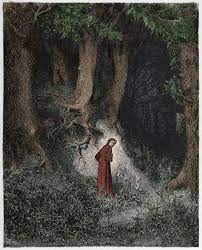
Dante’s Divine Comedy is squarely based on the Esoteric teaching but does not mention anything regarding self-remembering. Dante’s three animals, the ones with which he is lost in the woods, are clearly based on the basic Esoteric teaching that we are born temperamentally physically, emotionally or intellectually dominated.
Also called Man #1 (physical), Man #2 (emotional), or Man #3 (intellectual). Man #4 is an intermediate form, a step, a clear break away from the domination of inborn temperament, but not yet a Man #5, a man who is always self-conscious and the possesses the whole ensemble of free will, conscience, objective reason and immortality. We will get to Man #6 and #7 in Part Two. Man #4 is the missing half-note between mi and fa on the octave. Man #5 would be a stabilized person with continual self-consciousness, free will, conscience -such as to know good and evil completely-. along with objective reason and immortality.
I understood that these characteristics defined us as human, the result of having been bequeathed a soul, from about fourth grade on. This was all covered in our catechism. It was essentially a book of questions and answers describing what being a Catholic was about in terms of what would have to be called philosophic and theological terminology. We also got extensive Bible study without memorizing chapter and verse, but with a complete immersion in the Bible’s stories, from Adam and Eve, onward.
Getting back to Dante lost in the woods with his wolf, Dr Mazzarella talked about this intellectuality, not as e.g., objective interest in science but, rather, the use of the intellect for cunning, for everything from hunting to war.
If you read The Divine Comedy, you cannot really see what would have been “heretical”, but, without going into the details, it was. The teaching undermined the authority of the Vatican. More on this to come.
She maintained the Templars took the teaching back to Italy and we will get into the details beside the obvious ones regarding the three animal companions, which are Dante’s companions in the woods as he discovers he has lost his way.
This is an artistic version of the very doctrine at the core of Esoteric Christianity.
Beatrice is a symbol of the anima, the part of the psyche outside of the conscious mind. That’s who guides him. Not the doctrines of the Church. Though not expressed as such, actual real autonomy for the psyche means you are one who “brings not peace but a sword” as no one, pope or otherwise, can stand in for your connection to soul, and, thus, conscience.

I hope some of your readers leave me some feedback and I will base the blog’s second part on that.
Thank you for reading this.
 Contrary Warrior Health Blog